CBJJ Brazilian Jiu-Jitsu Competition Rules
2008
As Interpreted by:
Rick Sparks
BJJ Black Belt Under Helio Soneca
CBJJ Certified Referee
TN State BJJ Federation Chief Referee
This is not an official CBJJ document, use at your own risk.
The official rules can be found at www.cbjj.org
You are free to use document this however you wish, as long as you include all information on this title page including the author and the CBJJ caveat.
�Competition Area
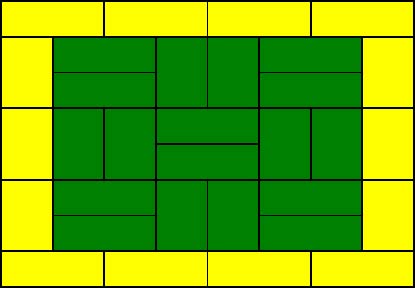
Needs to have a central area for the actual contest, and out of bounds demarcation, and a matted safety area at least 1 meter wide.
It might look something like this:
Scorekeeper/Timekeeper
1) Scorekeeper awards the points ONLY as directed by the referee. ONLY the referee has the authority to award points.
2) Timekeeper starts the time time when ever the referee says "Combate" or "Start", and interupts the time whenever the referee signals "Time Out".
3) If the referee stops the match, and it is clear that he just forgot to make the "Time Out" signal, the timekeeper should interrupt the time.
Competitor Gis and Equipment:
1) Only White, Blue, and Black gis are allowed. Solid color only, no mix and matching of the top and pants.
2) No hard protectors can be worn (technically, this includes cups, but the cup rule is not enforced.) So, no headgear. Also no knee pads with metal or hard plastic parts/covers.
3) No shoes of any kind.
4) Competitors MUST wear underwear. This will not be checked, but if you pants drop in the match, and you are commando, immediate disqualification.
5) Gi must be clean, and fingernails properly clipped.
6) Long hair must be secured so that it does not interfere with the match.
7) Gi sleeves must reach to the wrists with the wrists with arms extended in front.
8) Pants must extend to the ankles.
9) Both sleeves and pants should allow for the insertion of 4 fingers, with similar looseness at the elbows.
10) The skirt of the Gi top should reach the upper thighs.
11) If the gi becomes torn during the match, the competitor will be allowed a very brief intermission to replace the gi.
Assigning White vs. With Color.
1) One competitor is "white" and the other is "with color".
2) With color competitor will be identified by his gi and/or with a specially colored belt (yellow and green by cbjj, often red in smaller tournaments.)
3) Assigning sides:
a) White Gi is always "white"
b) Blue Gi is always "with color"
c) Black gi is "with color" when paired with a white gi, and "white" when paired with a blue gi.
d) If competitors have the same color gi, the top of the bracket is "with color".
Referee's Equipment:
The referee will wear a colored armband on the right wrist.
Scoreboard:
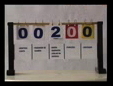
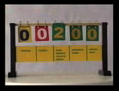
The scoreboard needs to have separate areas for scoring points, advantages, and penalties.
The points tabs should be white for white, and green with yellow for "with color", the advantages tab yellow, and the penalties tab red. In some smaller tournaments, the penalties tab is omitted.
White Scoreboard |
With Color Scoreboard |
|
|
Starting or restarting the Match:
1) Check your scoreboards to make sure they have been cleared from the previous match
2) As your competitors come out, check that their gis are proper length and untorn.
3) Check to be sure the belts are securely tied, and the fingernails are short.
4) Check for visible ringworm or staph.
5) Line up competitors on their lines, with the "with color" competitor on the same side as your "with color" wrist band (on your right arm), with the ref facing the scoreboard.
6) Check with your timekeeper that he/she is prepared to start the time.
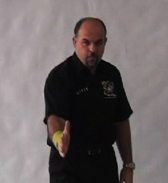
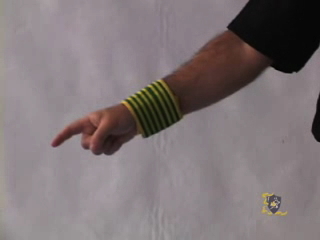
7) Karate chop in the center and say "combate" or "go".
Stopping the Match:
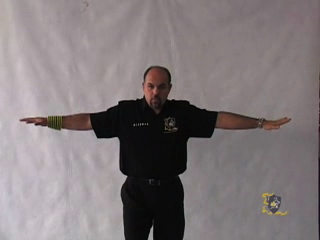
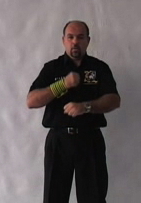
1) If the match needs to be stopped because time expired, a submission occurred, the competitors went out of bounds (as discussed later), or other reasons, the ref extends his arms starting at the chest with the palms down, and extending both arms into an airplane like position and calls "Parou" or "Stop".
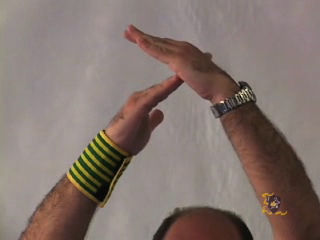
2) Make a "T" with your hands over your head directed at the score table to signal the timekeeper to stop the time.
3) The referee can ALWAYS stop the match to prevent serious harm to the competitors.�
Scoring
Submission: Automatic and Immediate Win
1) Tapping with hands or feet
2) Verbally submitting (saying tap, stop, I can't continue, etc.)
3) Saying Aieeee! Or other pain utterance while in a submission position.
4) Losing consciousness is the same as submitting.
5) Having to stop for cramps is the same as submission.
6) The referee can stop the match if he is sure that the opponent being submitted is in danger of severe physical injury. This is usually only done in children's divisions, or in white belt divisions. Use caution in making this call in any adult division, as this call WILL cause great controversy.
7) Submissions must be applied in a manner that allows the opponent time to submit before injury occurs.
Points: For obtaining some superiority, for example, passing the guard, or mount.
4 Points |
3 Points |
2 Points |
1) Mount
2) Back Mount
3) Back Grab
|
1) Passing the Guard
|
1) Takedown
2) Sweep
3) Knee on Belly
|
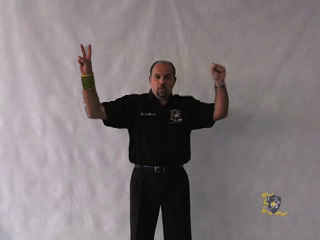
To Award Points
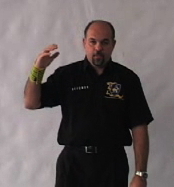
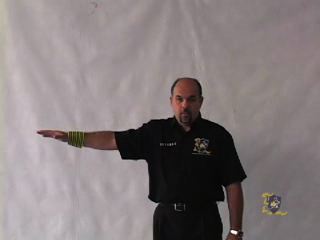
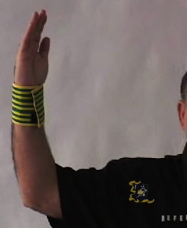
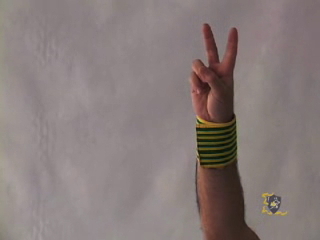
1) Raise the arm corresponding to the competitor who scored.
(right arm with armband for "with color", or bare left arm for "white")
2) Hold up the number of fingers corresponding to the number of points scored.
3) Do not use the thumb.
Advantages
Advantages: For almost accomplishing something that would be awarded points.
1) Almost passing the guard, getting knee on belly, getting mount, getting back mount, getting the back grab. This usually happens when you get the position, but don't hold it for 3 seconds. Moving from guard to half guard gets an advantage.
2) Almost getting the takedown. Significant loss of balance required, the opponent must almost fall. Or, takedown is achieved, but not held for 3 seconds.
3) Almost sweeping. Significant loss of balance required, the opponent must almost be swept. Or, sweep is achieved, but not held for 3 seconds.
4) Almost completing a submission hold. Note: You opponent must have to make a significant defense before an advantage is warranted. These should be limited to situations where the submission is deep and threatening. For example, the arm should be almost completely straightened in an armbar, or the choke should be deep and making the opponent's face a little red.
5) Repeated attacks that wouldn't normally merit an advantage, but when the opponent is continually defending, and not initiating his own attacks. For example, one competitor is trying to sweep and submit from the guard many times, but the other competitor is clearly not trying to pass. This could also warrant a stalling penalty.
6) Both competitors pull guard simultaneously. One comes back on top, and holds for 3 seconds. Score advantage for person who comes on top.
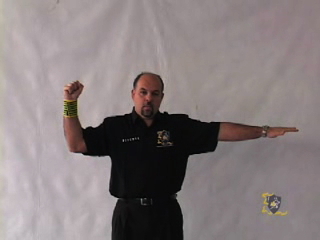
To Award Advantage:
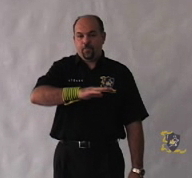
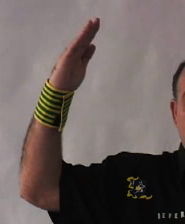
1) Start with hand across chest, hand in flat position.
2) Extend arm out to horizontal.
3) Use arm corresponding to competitor "color"
�Details on How to Score Points and Advantages
Take Downs: 2 Points
General Observations:
1) ALL takedowns MUST start from the feet. The thrower's knees can touch during the takedown, but the throw must continue without pause. For example, if you are shooting a double and go to your knees during execution, but the motion is continuous, 2 points.
2) However, if your progress stops, but then you restart (still on your knees), hold the knees and stand and then take him down, this does not score.
3) Opponent can have one knee on the ground, but not both. If opponent has both knees down, score advantage.
4) If you are touching the leg with your hand, and your opponent pulls guard, this is considered a takedown, so 2 points.
Three Basic Types of Takedowns:
1) A throw where person being thrown lands on the back or side, and the thrower does not end up in the guard. In this situation, it is not required that you maintain the top position for 3 seconds. Points are awarded right away. Examples: Judo throws like tai-toshi, haria-goshi, seio-nage. Or double leg with lift and tilt that ends in side control. Note: If such a throw is executed, and the throwee immediately reverses the position and comes on top, the thrower is awarded 2 points, and the throwee an advantage.
2) Takedowns where the person being thrown does not land on his back or side, and/or the thrower ends up in guard. This situation requires that the thrower maintains the top position for 3 seconds. Examples: Single leg to run the pipe, double leg with foot trip.
3) Takedowns where the person being thrown ends up on his knees and the thrower ends up on the throwee's back. a) Thrower must maintain the back position (no hooks required) for 3 seconds. b) He must have advanced from the throwee's front to the throwee's side or back. For example, if you snap someone down and are on top in a sprawl position, but cannot get around his arms, no points. But if you advance around to a wrestler's referee position, and hold for 3 seconds, 2 points.
Near Take Down:
If the thrower creates an obvious and significant off balancing, award an advantage.
Take Down then Opponent Sweeps:
If the competitor gets a takedown, but before 3 seconds his opponent sweeps, no points for the takedown, 2 points for the sweep.
Sweeps: 2 points.
1) ALL sweeps MUST start from the guard. A complete reversal starting from being in side control is NOT a sweep. There is no score for such a move.
2) A sweep takes the player from being in guard bottom to the top position, either in the guard or otherwise. This includes the back position, with or without hooks. But not the sprawl position, you must advance around your opponent's arms to a wrestling referee's type position.
3) You must maintain the top position for 3 seconds. If you sweep but do not maintain top position for 3 seconds, you get an advantage.
4) If your opponent pulls guard when you already have guard, and you come up to your knees or standing, this is considered a sweep, 2 points.
5) If you opponent lies back for a leg lock, and you sit up and successfully defend, this is considered a sweep, 2 points.
6) Sweeps can start in the half guard, or any guard. (Turtle guard is not a true guard)
Passing the Guard: 3 points
1) Moving from inside the full, half, open, etc. guard, and fully passing the legs, opponent can be on his back, side, or belly.
2) This position must be maintained for 3 seconds
3) If the opponent comes to his knees, it is not a pass, but is almost a pass, so award an advantage.
4) Moving from full guard to half guard, award an advantage. But be a little patient, just in case he completes a full pass right away.
5) If the competitor moves around the legs, but does not maintain the position, score an advantage.
6) The guard position starts when any foot contact is made with the opponent's legs, hips, or the opponent grips the legs.
Knee on Belly: 2 points
1) Inside knee across the belly, other FOOT on the ground, knee up. No grips required.
2) Must hold for 3 seconds.
The Mount: 4 Points.
There are 2 variations of the basic mount. This is considered the same position for scoring purposes, so you do not get additional points when moving from mount to side mount, or vice versa.
1) Mount: Opponent is on his back.
a. You must have at least one knee on the ground.
b. You can be over one arm but not both.
2) Side Mount: Opponent is on his side.
a. You must have at least one knee on the ground. Sometimes called the technical mount.
b. This is NOT the same as side control. Your legs must be on opposite sides of your opponent's body.
c. You can be over one arm but not both.
The Back Mount: 4 Points
1) Opponent is on his belly, but NOT on his knees.
2) You must have at least one knee on the ground.
3) You can be over one arm but not both.
4) For scoring purposes, this is a different position than the mount, so you get 4 more points for moving from mount to back mount or vice versa.
For all Mounts, you must hold for 3 seconds. If less than 3 seconds, score advantage.
The Back Grab: 4 Points
1) On the opponent's back with both hooks in, that is on your opponent's inner thighs, or at your opponent's hips.
2) Feet not crossed
3) No body triangle.
4) Opponent cannot have a headlock.
5) You can have a leg over one arm, but not both arms.
�Multiple Scores
There will be times when a competitor will perform multiple scoring actions in rapid succession. When this occurs, all points and advantages for all scoring actions should be awarded when the final position is held for 3 seconds. However, if the competitor almost accomplishes these things, he should get advantage(s).
Scenario One: For example, a competitor could get a take down and end in the guard, and before holding the opponent down for 3 seconds, pass his guard, and then move to knee on belly. In such situations, the competitor should get points for all scoring actions, as long as the final action is held for 3 seconds. So, in this example, when the competitor had secured the knee on belly for 3 seconds, he would be awarded 2 points for the takedown, 3 points for the guard pass, and 2 points for knee on belly, for a total of 7 points.
Scenario Two: For example, if the competitor got the takedown, passed before 3 seconds, went immediately to knee on belly, and then his opponent escaped and stood up before being held 3 seconds in knee on belly, the thrower would get 3 advantages, 1 for an almost takedown, one for an almost guard pass, and one for an almost knee on belly.
Scenario Three: For example, if the competitor got the takedown, passed before 3 seconds, went immediately to knee on belly, and then his opponent escaped and ended in side control, and was then held 3 for seconds in side control, the thrower would get 2 points for the takedown, 3 points for the guard pass, and 1 advantage for the almost knee on belly.
Scenario Four: For example, if the competitor passes the guard, and immediately opts to try for an armbar instead of maintaining side control for 3 seconds, and he gets his opponent's arm straight but cannot finish, and his opponent ends up on top, he will not be awarded points, but only an advantage for almost passing the guard, and an advantage for almost getting the submission.
Important Note: Multiple Scores will not be awarded for the same action that does not advance your position. For example, knee on belly on one side, followed by knee on belly on the other side only scores ONCE. Knee on belly to side control to knee on belly, when done solely to score points does not result in an additional score. However, if the opponent rolls from mount to back mount or back grab repeatedly, the score continues to accumulate, since the game cannot be advanced any further than these positions.
�Waiving Off Incorrect Scores
Referees will make mistakes occasionally. In this case you need to signal the score board to remove points previously awarded. To do this, raise one arm corresponding to the competitor color from which the points need to be removed, and wave your arm back and forth. If there is confusion about which points to remove, you can hold up the points to be removed with the same hand as you wave off the score.
Ending the Match
1) When a submission occurs, or the time expires (the score table will indicate the end of the time with an audible signal, and by throwing some object into the ring), the referee will call "Parou" or "Stop" and make the appropriate gesture.
2) The referee will check the score if no submission occurred, and award the win to the competitor with the most points.
3) If the points are tied, the referee will award the win to the competitor with the most advantages.
4) If the points and advantages are tied, the referee will award the win to the competitor with the fewest penalties.
5) If the points, advantages, and penalties are tied, the referee awards the match to the competitor that he feels had the overall advantage, or pushed the action more.
6) In a local tournament, if penalties are not being tracked, skip #4.
7) After awarding the match, confer with the score table to make sure that right person advances.
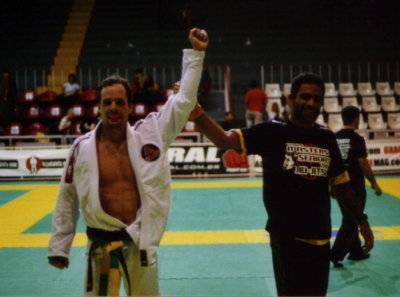
Award the Win
1) Face the Score table
2) Hold Both Competitors Wrists, with correct color on each side.
3) Raise arm of winner.
4) Repeat Facing the Crowd.
5) If loser leaves the ring, perform with winner only.
�Injuries:
If a competitor is injured:
1) If the injury is not due to an illegal action by his opponent, he loses.
2) If the injury is caused by an illegal action by his opponent, the opponent is disqualified. Injured party gets the win.
3) If the competitor is slightly injured (for example an unintentional groin strike or eye poke), he should be given a little time to recover, then the option to continue the match.
Out of Bounds:
1) If competitors go out of bounds standing, stop the match, return them to the center standing and restart.
2) If competitors go out of bounds in a wild scramble on the mat, with no clear advantage to either, stop the match, return them to the center standing and restart.
3) If competitors go out of bounds in a definite position (for example, side control, in guard, mount, back grab, etc.) wait for the position to stabilize a little, then pull them into the center and restart in exactly the same position. NOTE! Be sure to tell them to "freeze, don't move" when you stop them, and very carefully note the position of hands, feet, grips, etc. When they get to the center, and there is debate about the position, you the referee MUST make the call as to where the grips go, and exactly how the position will start.
4) If the competitors go out of bounds in a submission position, you MUST NOT restart them in the center in a submission position. If it is safe for them to continue, try to let the submission position resolve (that is, a tap or an escape) before stopping the match and restarting it in the center. If it is not safe for them the continue (for example, they are off the mat on a hard surface, or have rolled onto a mat space where another contest is in action, you must stop the match, give the person who was applying the submission 2 points, and restart them standing in the center.
5) Actions that start in bounds are legitimate scoring actions even if they end out of bounds. This includes sweeps, takedowns, submissions, etc.
The yellow is the out of bounds safety area.
Minor Penalties
1) Competitor pulls guard or kneels without first holding the opponent's gi.
2) Leaving the combat area to avoid combat or to stall
3) Intentionally removing kimono to stall
4) Putting fingers inside the opponents sleeves or pants openings.
5) Stalling (Always gets one verbal warning)
Scoring Minor Penalties
1st Offence:
Verbal Warning
2nd Offence:
a) Roll Hands
b) Raise Offender side arm at right angle with fist
c) Award advantage to opponent
d) Scorekeeper gives one penalty to offender and advantage to the other competitor.
3rd Offence:
a) Roll Hands
b) Raise Offender side arm at right angle with fist
c) Award 2 points to opponent
d) Scorekeeper gives one penalty to offender and 2 points to the other competitor.
4th Offence:
Referee may give opponent 2 points as above, or DQ at his own digression. DQ should be given when the competitor is intentionally and repeatedly breaking the rules.
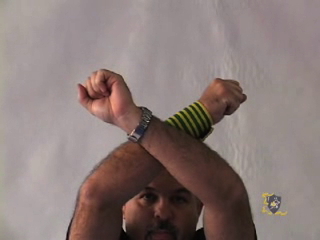
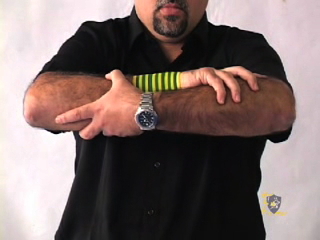
How to Call Stalling
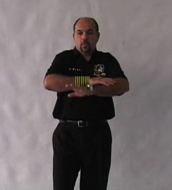
1) Cross arms in front of body, holding both forearms.
2) Say "Lute" or "fight" or "Stalling".
Calling Penalty With Advantage
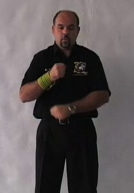
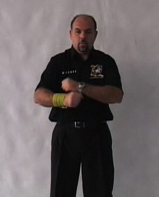
1) Roll Hands with Fists
2) Raise arm with fist at 90 degrees on side of penalized competitor.
3) Award Advantage to his opponent.
Calling Penalty With Points
1) Roll Hands with Fists
2) Raise arm with fist at 90 degrees on side of penalized competitor.
3) Award Points to his opponent.
Disqualifications:
Serious Fouls (DQed from the entire tournament)
1) Ringworm/Staph: If competitor has visible ringworm or staph, they are immediately disqualified. No exceptions.
2) The use of foul language or disrespect toward the opponent, the referee, or the assisting public. Competitors CAN be DQed for the actions of their coaches. Example: Coach comes on the mat and interferes with match, or disrespectfully argues with the referee while being on the mat. Threatening behavior of any kind from the competitor or coach should result in immediate DQ from the entire tournament.
3) Biting, Hair pulling, Putting Fingers in any orifice.
4) Intentionally striking the genitalia or other parts of the body with intent to hurt or gain unfair advantage.
5) Blatant disregard for the referee's instructions, especially if safety is impacted.
Technical Fouls (DQed from the current match only, may continue in the tournament)
1) If a competitor cannot remedy an illegal or torn gi in a reasonable amount of time, he is disqualified.
2) The fighter must wear underwear under the pants. This will not be checked, but if de-pantsing occurs during the match, disqualification if no underwear.
3) Moving out of bounds to avoid being submitted while not trying a legitimate escape.
Illegal Techniques For Everyone: (DQed from the current match only, may continue in the tournament, unless done to intentionally cause harm, for example performing such a technique after immediately being warned not to.)
1) Cervical (Neck) locks or cranks.
2) Slam from the Guard
3) Heel Hook or Knee Twisting Lower Body Submission.
4) Scissors Takedown
5) Small joint (fingers) manipulations (pulling back) for submission or escape.
6) Slam from submission position (slamming while being arm barred or triangled)
Illegal Techniques for Purple and Below (DQed from the current match only)
1) Mata Leao with foot (Figure 4 Toehold)
2) Knee Bars
3) Bicep or Calf Slicer/Pinch
Note: So, for purple and below, the only lower body submissions allowed are straight ankle locks.
�
Signaling Disqualification
1) Line up competitors facing the score table.
2) Cross Arms with Fists Over Head
3) Point at Disqualified Persons Belt
4) Raise arm of his opponent and award win
Miscellaneous Notes:
1) Competitors should be allowed a minimum rest time between matches of 2x their competition times.
2) If both athletes are injured during the match and cannot continue, assuming no violations of the rules, the winner is determined in the normal fashion.
3) Competitors MUST engage. For example, if your opponent is in open guard, you cannot simply back up and run away, you must engage him and try to pass. Failure to due so will result in a penalty, and ultimately (after many times) disqualification.
Some Final Advice for Referees:
1) Maintain control of the ring. Show confidence in your calls. Make the best decision you can, and MAKE THE CALL. Try not to hesitate or be unsure.
2) If you make a mistake, fix it right away.
3) One of the referee's responsibilities is to ensure that the scorekeeper puts up the correct score to the correct player. After each score, try to move to a position where you can still observe the match, but quickly look up and check the scoreboard.
4) Direct the competitors to shake hands after awarding the win.
5) You are human, you will make mistakes. Just try to fix them right away. The most important thing is that the correct competitor leaves the ring with the win.
�Match Times
ADULT: (18 - 29)
A. WHITE- 5MIN
B. BLUE- 6MIN
C. PURPLE -7MIN
D. BROWN- 8MIN
E. BLACK- 10MIN
MASTER:(30-35)
A. BLUE -5MIN
B. PURPLE -6MIN
C. BROWN- 6MIN
D. BLACK- 6MIN
SENIOR:(over 35 according to the tournament)
A. BLUE -5MIN
B. PURPLE- 5MIN
C. BROWN- 5MIN
D. BLACK- 5MIN
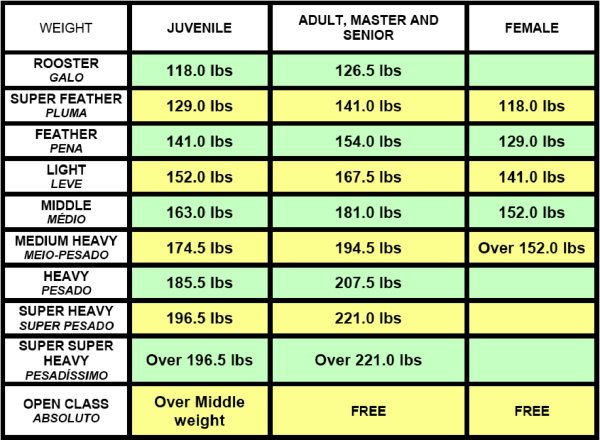
Weight Classes (With the Gi On)
|